Why Indicator Choice Matters More in Scalping
Scalping is one of the most demanding trading styles in forex. You’re working on 1-minute to 15-minute charts, targeting anywhere from 3 to 20 pips per trade, and every second of lag — whether in your execution or your analysis — costs real money. That’s why choosing the right indicators for scalping isn’t just a preference; it’s a performance requirement.
The core challenge is noise. On lower timeframes, price moves erratically. Indicators that work beautifully on a 4-hour chart can generate a flood of false signals on a 1-minute chart. This article cuts through the clutter and focuses on indicators that have proven genuinely useful for scalpers — and, just as importantly, explains why they work and how to use them correctly.
The Workhorse Indicators for Scalping
Exponential Moving Averages (EMA)
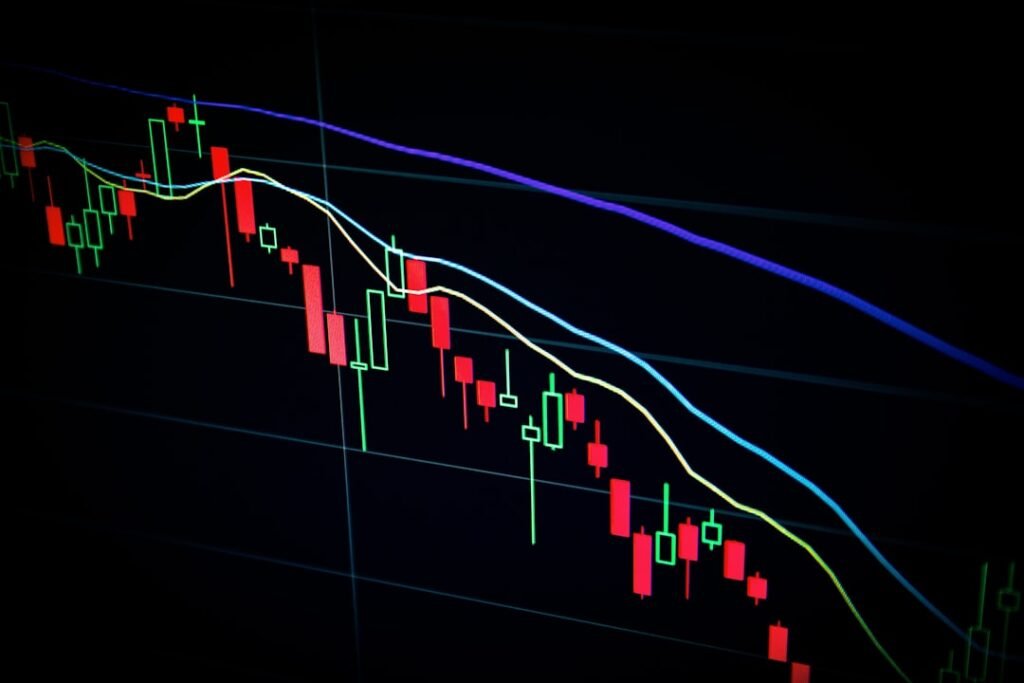
The EMA is the backbone of most scalping setups, and for good reason: it reacts faster to recent price changes than a simple moving average, making it far more responsive on short timeframes. The most common scalping configurations use a fast/slow EMA combination — for example, the 9 EMA and 21 EMA, or the 5 EMA and 20 EMA on a 5-minute chart.
The basic rule is straightforward: when the fast EMA crosses above the slow EMA, it signals upward momentum; a cross below signals downward momentum. But experienced scalpers don’t trade the crossover blindly. They look for crossovers that occur after a clear price pullback, where the angle of both EMAs confirms the trend direction. A flat or tangled EMA pair is a signal to stay out — the market is ranging, and scalping against choppy conditions is a fast route to losses.
Bollinger Bands
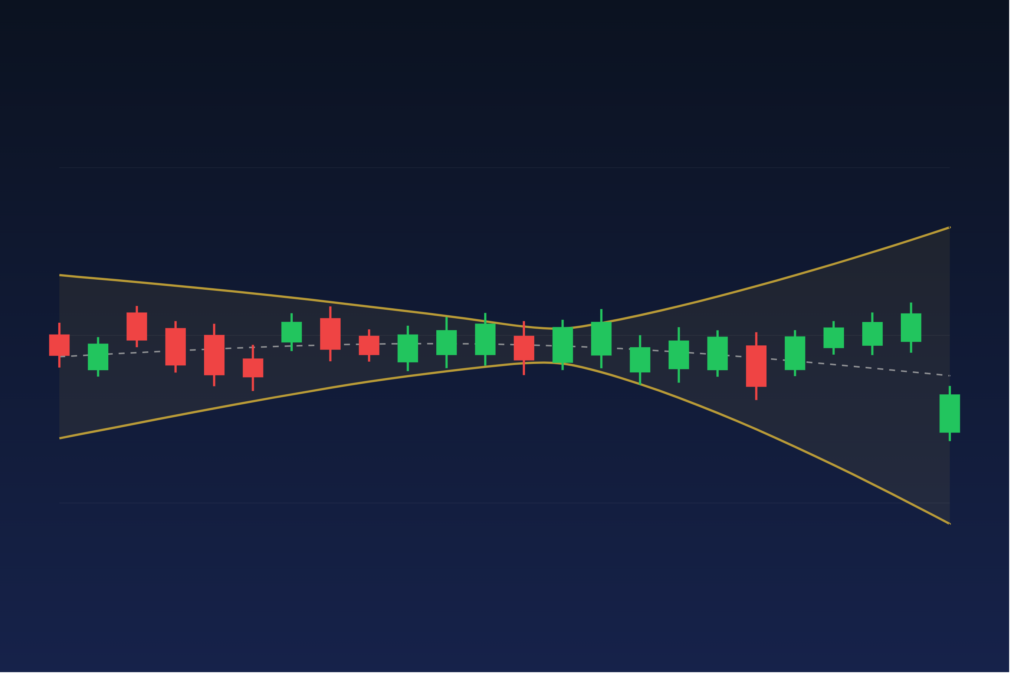
For scalpers, Bollinger Bands serve two distinct purposes: identifying volatility compression and spotting overextended price moves. When the bands squeeze tightly together (often called a “Bollinger squeeze”), it indicates that volatility has contracted — and a sharp directional move is likely approaching. Scalpers watch for the breakout from this squeeze and enter in the direction of the expansion.
The second use is mean reversion: when price touches or briefly penetrates the outer band and momentum indicators show exhaustion, price often snaps back toward the 20-period middle band. This is a popular scalping signal on pairs with tight spreads. The key mistake to avoid is treating every band touch as an automatic reversal — in a strong trend, price can ride the outer band for extended periods. Always combine Bollinger Bands with at least one momentum confirmation tool.
RSI and Stochastic Oscillator
Both the RSI (Relative Strength Index) and the Stochastic Oscillator are momentum oscillators, and in scalping they’re most effective as confirmation tools rather than primary signals. Using a 7-period or 9-period RSI (shorter than the standard 14) makes it more sensitive to fast price swings on lower timeframes.
The idea is simple: if your EMA or Bollinger Band setup points to a long trade, check whether RSI is rising from below the 50 line, or whether the Stochastic lines have crossed upward from the oversold zone (below 20). This layered confirmation approach filters out a significant portion of false signals. Avoid entering a trade just because RSI is “oversold” on a 1-minute chart — on its own, that tells you very little without directional context.
How to Combine Indicators Without Overloading Your Chart
One of the most common mistakes new scalpers make is stacking indicator after indicator in search of a “perfect” signal. The result is paralysis — by the time five indicators align, the move is over. The most effective scalping setups use a maximum of two or three indicators with clearly defined roles.
A practical and well-tested combination looks like this:
- Trend filter: 20 EMA and 50 EMA to define the direction and whether price is in a trending or ranging phase.
- Entry trigger: Bollinger Bands to identify a squeeze or an outer-band touch with a pullback toward the midline.
- Momentum confirmation: Stochastic Oscillator (5,3,3 settings) to confirm momentum aligns with the intended trade direction before entering.
This structure gives you a trend context, an entry reason, and a confirmation — without overwhelming your decision-making. It’s also worth paying attention to key support and resistance levels; scalping near well-established levels gives your setups additional context and helps you target logical exit points.
What Doesn’t Work Well for Scalping
MACD is a popular indicator, and it’s genuinely powerful on higher timeframes — but its lagging nature makes it poorly suited for 1-minute or 5-minute scalping. By the time a MACD crossover forms and confirms on a fast chart, much of the move has already happened. It can be used as a very broad directional filter on a slightly higher timeframe (e.g., the 15-minute chart) while you scalp on the 1-minute, but it should not be the trigger in a pure scalping system.
Similarly, Ichimoku — while an excellent multi-purpose tool on daily or 4-hour charts — generates signals that are simply too slow for the scalping environment. Its cloud, lagging span, and conversion/base line interactions require time to develop context that a scalper doesn’t have.
Avoid volume-based indicators unless your broker provides reliable tick volume data. Many retail forex platforms show tick volume rather than true traded volume, which can be misleading on very short timeframes.
Setting Up and Automating Your Scalping Tools
Once you’ve settled on a scalping indicator combination, consistency in setup is critical. If you’re using MetaTrader, adding and configuring custom indicators is straightforward — you can find step-by-step instructions for MT4 and MT5 to get your workspace ready quickly.
For traders who want to remove hesitation from the scalping process entirely, algorithmic tools can be worth exploring. MGH Products offers a range of MetaTrader indicators and Expert Advisors at mghfx.com designed to support systematic and semi-systematic trading approaches — potentially useful for scalpers who want rule-based execution without the emotional drag of discretionary decisions.
Final Thoughts
The best scalping indicators aren’t necessarily the most complex — they’re the ones you understand deeply and can apply consistently under pressure. EMA pairs for direction, Bollinger Bands for entry context, and Stochastic or RSI for momentum confirmation form a tested, logical toolkit that gives scalpers genuine edges without signal overload. Pair these with disciplined risk management and a focus on liquid sessions, and you have a framework that can perform across market conditions.
This article is for educational purposes only and does not constitute financial or investment advice. Always trade responsibly and consider your personal risk tolerance before entering any trade.
Photo by Arturo Añez on Unsplash